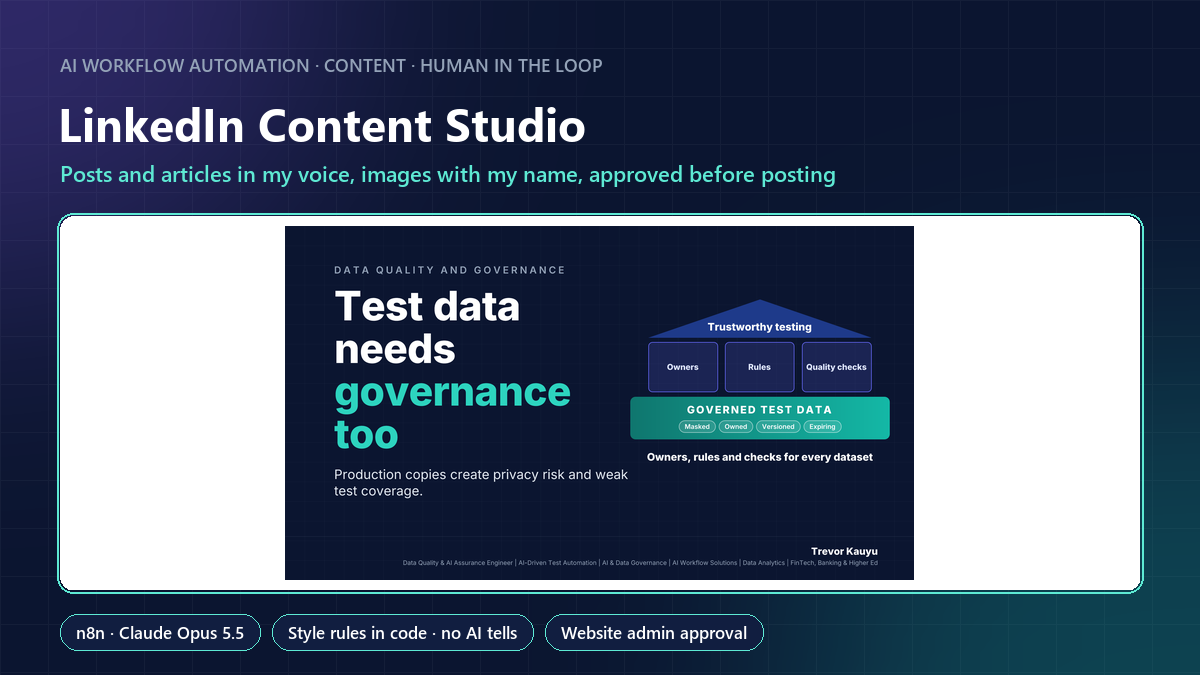
Problem
Posting regularly takes time, and posting on several platforms takes more: each one has its own length, link rules and habits. Most AI-written posts are also easy to spot: long dashes, "delve", "game-changer", tidy lists of three. Fully automated posting is worse: one bad post goes out under your name. I wanted help with the writing, images and comments, in my own voice, without giving up control.
Approach
I built it as Content Studio in this website's admin, with an n8n workflow doing the AI and platform work, on one design rule: the AI writes; code checks the writing and draws the images; I approve; the APIs post.
- Schedule or on demand. I pick days, time and a searchable timezone, how often a draft is a full article, the platforms, and a queue of topics. A Generate now button takes a topic and a short description.
- One version per platform. LinkedIn, X, Facebook, Instagram, Threads and Bluesky each get their own text, written for that platform: 280 characters on X, 300 on Bluesky, no links in Instagram captions, a link card on Facebook and Bluesky.
- My structure and voice. My published articles are sent to Claude as the model to follow. Code checks the structure (italic personal opening, plain-word sections ending in "Final thought", a bold key line, the infographic's place, a closing question).
- No AI tells. A style check in code, shared by n8n and the admin editor, blocks long dashes, about 60 machine-sounding phrases, Markdown, placeholders and each platform's limits. Problems go back to Claude once; anything left blocks approval. My own three articles pass it.
- Images drawn by code. Claude writes only the words and picks a diagram; the site draws the cover and infographic in my design, with my name and titles in the footer.
- Approval in one click. A Review tab shows every platform's version side by side with the style check live; I can edit or untick a platform, and one Approve saves, approves and opens the next draft. A History tab keeps every item with its status on each platform.
- Connected or not. n8n posts to the platforms it's connected to; for the others, the admin gives me copy, download and open buttons so posting by hand takes a minute.
- Safe with the platforms' APIs. Official APIs only, no scraping. Work is claimed so it's never done twice, and posting calls never retry.
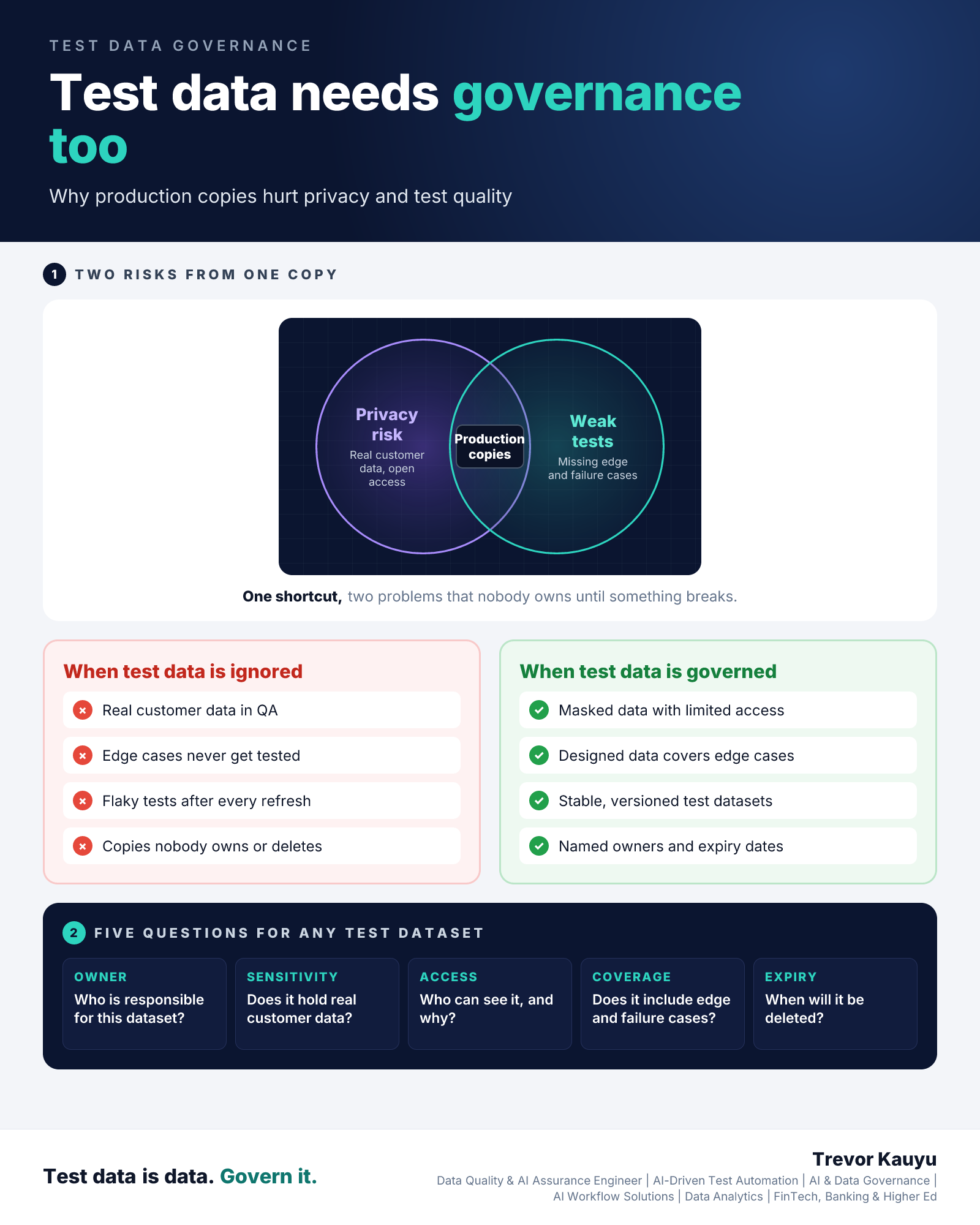
Result
Tested end to end on 2026-11-21 against mock APIs for all six platforms that check requests the way the real ones do (X's weighted length, Instagram's JPEG-only rule, Threads' processing delay, Bluesky's byte-offset hashtags): 22 of 22 quality gates passed, in three phases with my approval in between.
- Both drafts passed the style check first time on every platform: no long dashes, no AI phrases, each version within its platform's limits, and the article matched the structure of my earlier articles.
- Exactly one post per approved item on each of the six platforms, each linking to the article the right way for that platform; the article live on this site.
- Comments read once, my own ignored; spam neither liked nor replied to; approved replies posted once, in the right thread.
- 56 offline tests on real Claude responses and 53 unit tests on the style rules, platform limits, timezones, schedule and LinkedIn links.
- About $0.13 per article and $0.08 per post with six platform versions, under $0.01 per reply.
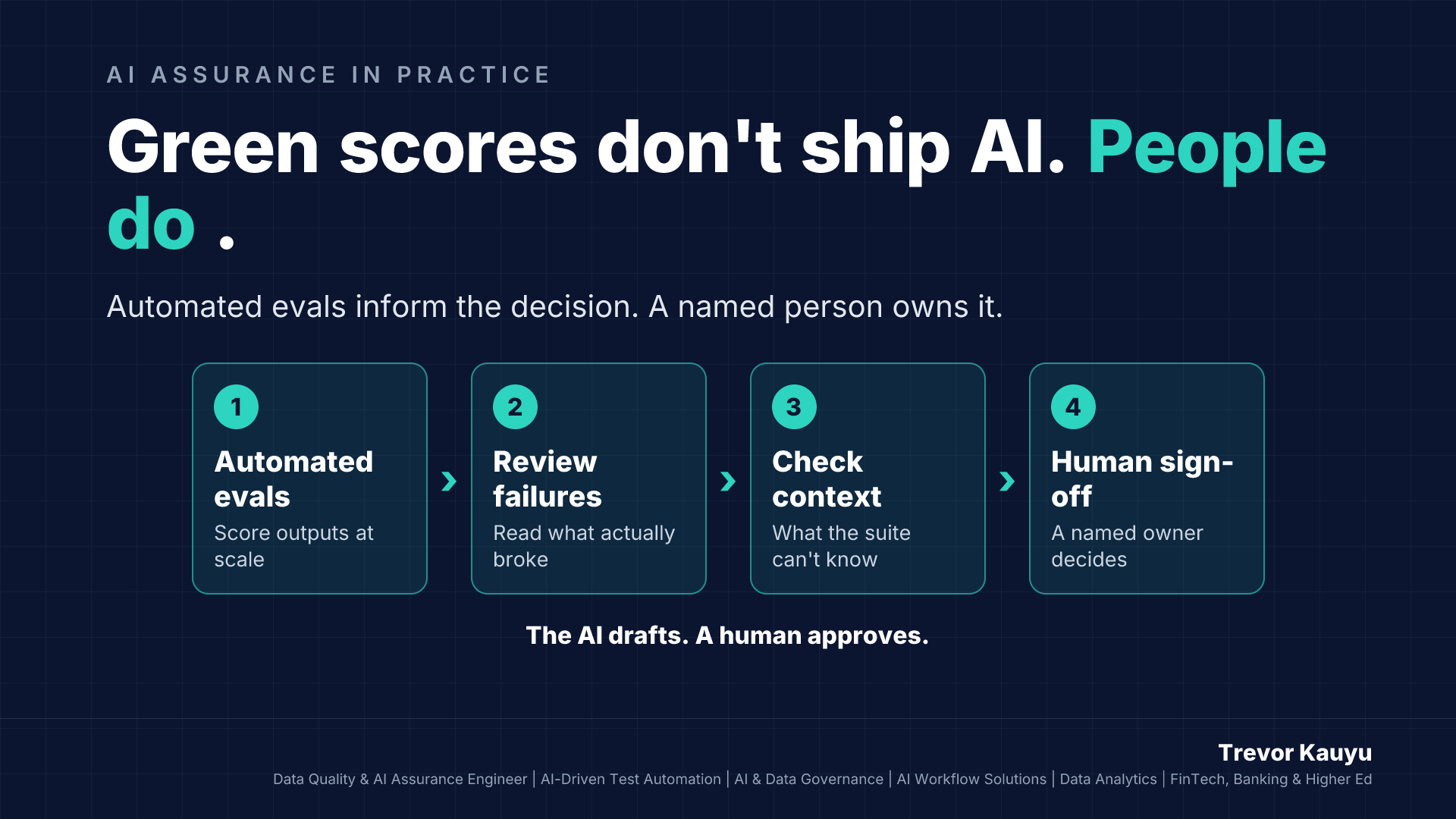
What this shows
Generative AI put to work under real controls: the model's output is checked by deterministic rules per platform, the brand and identity are rendered by code, a person approves every public action, and the integrations respect each platform's API limits and never post twice.