Problem
EcoCash is Zimbabwe's largest mobile money operator. Customers use Twitter to complain about failed transactions, network problems and charges, and rising complaints can signal that customers are about to switch to a competitor. The dissertation asked: how have complaints changed, what drives them, and how do they line up with the operator's active subscribers?
Approach
- 409,453 tweets (January 2017 to October 2021) cleaned down to 28,455: removed 145,290 tweets from the companies' own accounts, charity and disaster-relief tweets, internet-shutdown campaigns, extreme outliers and 348 non-English tweets.
- NLTK VADER sentiment: 14,342 positive, 7,754 negative and 6,359 neutral; negative and neutral tweets were kept as complaints.
- Complaint trends by month and quarter, compared with POTRAZ quarterly active mobile money subscribers for EcoCash, OneMoney and Telecash.
- A hybrid LSTM-CNN (Conv1D, max pooling, LSTM) forecasting EcoCash's active subscribers 120 days ahead.
Result
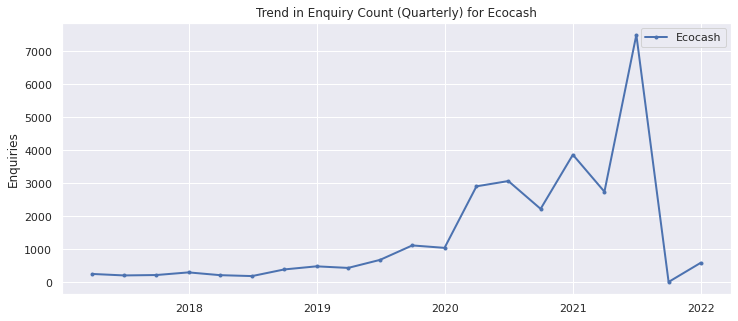
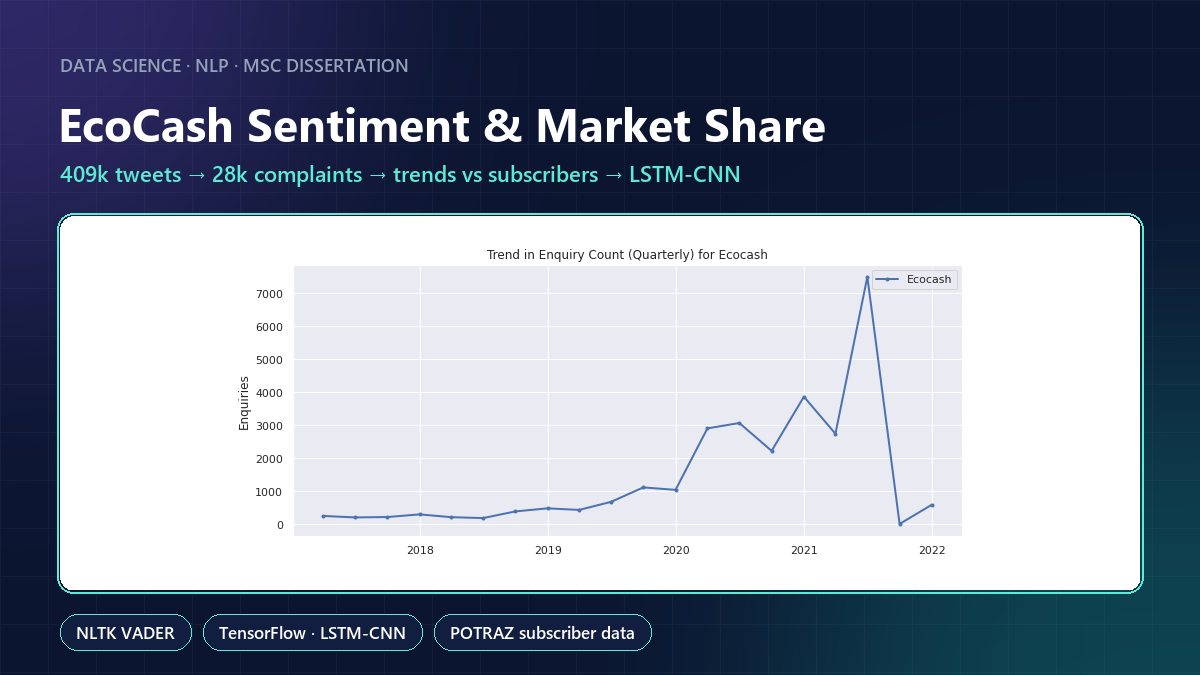
- Complaints were flat until early 2019, rose through 2019 and jumped in 2020–21, peaking at about 7,500 in one quarter of 2021.
- Network (Econet) and wallet (EcoCash) issues made up 49% and 37% of the complaint terms investigated.
- Subscribers kept growing as complaints rose; the forecast continues that rise.
Limitations, stated in the write-up: the forecast uses subscribers only (sentiment is not a model input), the quarterly series is spread across days so its low loss isn't proof of accuracy, and VADER can't read Shona or Ndebele.
What this shows
End-to-end NLP on messy social data, where most of the value is in documented cleaning decisions, plus deep-learning forecasting and an honest reading of what the model can and can't support. Personal Twitter handles are masked in the published notebooks.