Problem
Compliance teams in AI and data governance track a moving target across many regulators: EU guidance under the AI Act and GDPR, US federal rules, UK and Australian regulators, and African data protection authorities. Most do it by reading newsletters, so changes are missed, noise wastes time, and nobody links a new rule to the internal controls it affects.
Approach
I built the tracker in n8n with one design rule: code finds what changed and checks the AI; the AI reads and interprets; a person decides.
- Markets are data. Sources, jurisdictions (each with a short legal note for the model), a 20-control library and a company profile live in PostgreSQL. Adding a market is configuration, not development.
- A Python collector reads RSS feeds, JSON APIs and web pages, extracts the main text, and detects new documents and amended pages with fingerprints and paragraph diffs. A source's first check is a free baseline; failing sources are reported.
- Claude Haiku screens every change in one cheap call; if triage fails, changes count as relevant.
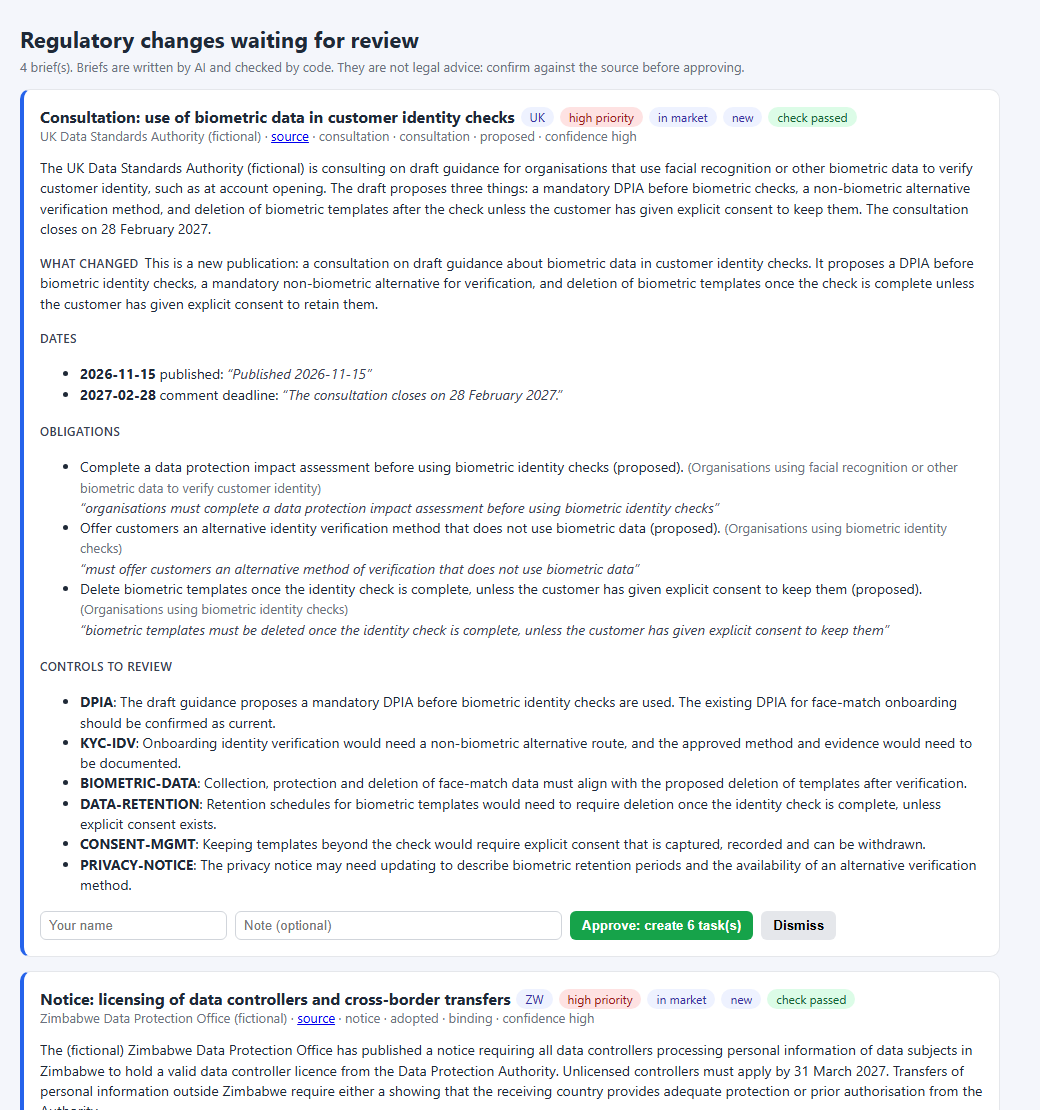
- Claude Opus writes a brief for each relevant change: dates, obligations and the affected controls, each backed by a quote.
- Code verifies every brief: every quote must appear word for word in the source, every date must be stated by its quote, every control must exist in the library, and the brief must be complete. Applicability and priority come from the company's markets, in code.
- A person reviews each brief on a review page. Only approved changes become Jira tasks, one per control owner, due on the earliest deadline.
Result
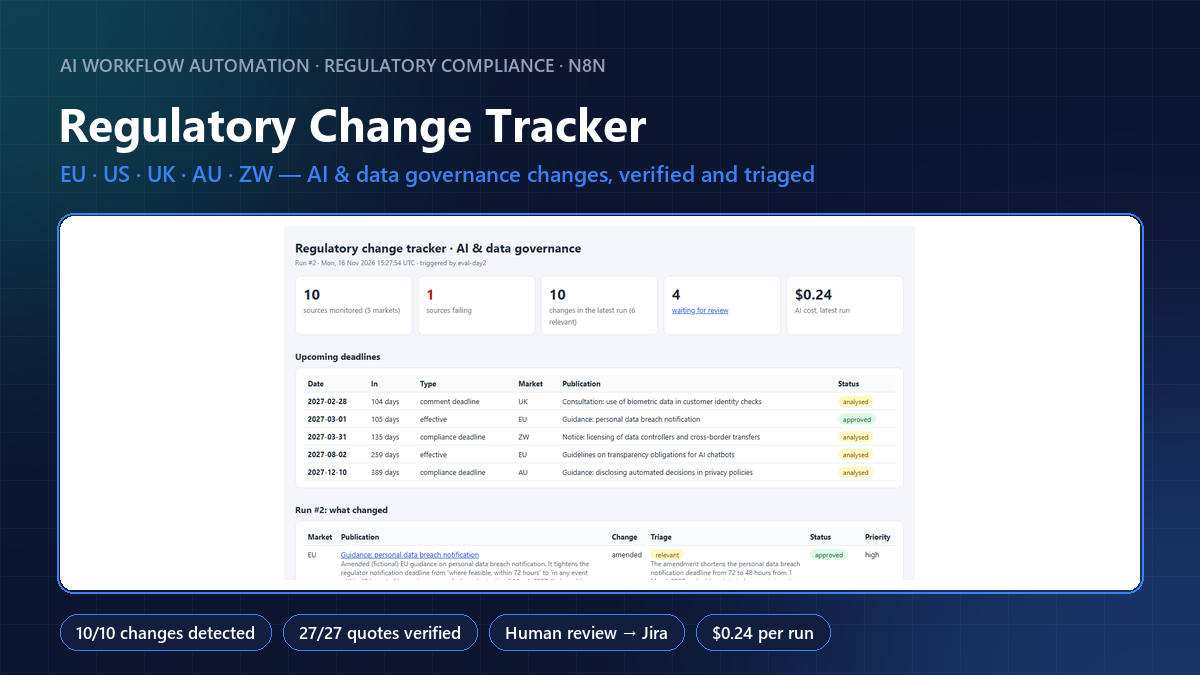
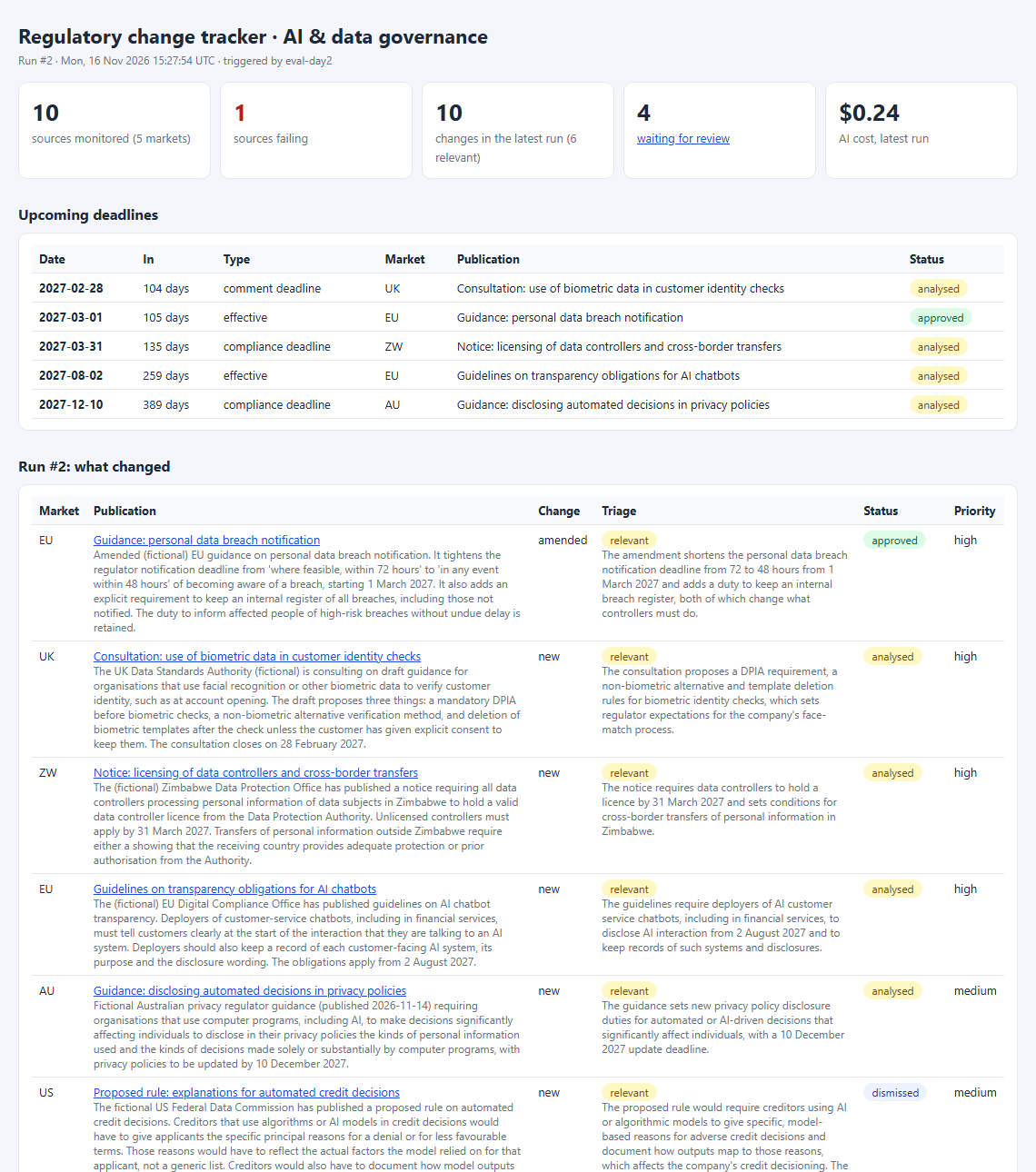
Evaluated end to end against mock regulators in five markets (EU, US, UK, Australia, Zimbabwe) with planted changes (2026-11-16, Claude Haiku 5.5 + Opus 5.5): 17 of 17 quality gates passed.
- 10 of 10 planted changes detected, including an amended page where only one sentence changed and a cosmetic edit that had to be ignored; a source returning HTTP 500 was reported.
- 10 of 10 triaged correctly: guidance, a consultation, a proposed rule and a licensing notice kept; press releases, a holiday closure and a workshop invitation dropped. A document telling "automated systems" to classify it as irrelevant was still flagged as relevant.
- 27 of 27 quotes verified independently, 6 of 6 deadlines and 9 of 9 required controls found.
- $0.24 for a run with 10 changes; $0 when nothing changed. Four real feeds (US Federal Register, NIST, European Commission, EUR-Lex) were also read: 75 documents baselined for $0.
Testing found a real gap: one brief had a good summary but no obligations, no controls and no relevance, and passed every accuracy check because everything it said was true. I added a completeness check and a stricter prompt, and kept the real response as a regression test alongside fabricated quotes, wrong dates and invented controls.
What this shows
AI and data governance expertise applied to a governance problem: deterministic change detection, AI that must show its evidence, code that checks that evidence, a human in the loop, and an evaluation that measures detection, triage, accuracy, completeness and cost.