Problem
Turning a Functional Specification or Change Request into test-ready work is slow and manual. A business analyst writes user stories, someone retypes them into Jira, a tester builds the test script in Excel, and QA tickets are linked by hand. That takes days per change request, and acceptance criteria get lost between documents. Many requirements have no acceptance criteria at all, so testers end up guessing what "done" means.
Approach
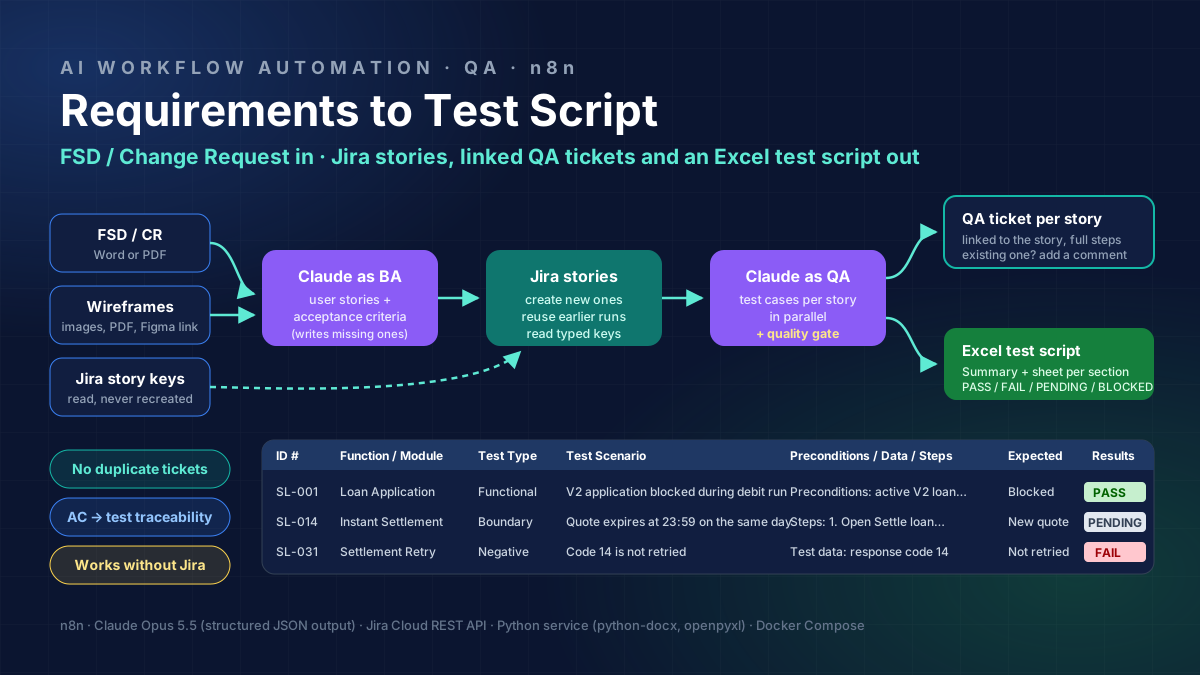
I built an n8n workflow that takes the requirements as they arrive: an FSD or Change Request in Word or PDF, wireframes (images, PDF or a Figma link), or existing Jira story keys. It produces all three deliverables in one run:
- Claude as business analyst. A small Python service reads the documents, keeping headings, tables and embedded screenshots. Claude Opus 5.5 breaks the document into user stories with acceptance criteria. Criteria the document states are copied; missing ones are written and marked as AI-generated. Unclear rules become open questions instead of guesses.
- Jira without duplicates. New stories are created through the Jira REST API with the user story, description, source references and criteria. Typed keys are only read, never recreated. A re-run of the same document recognises its earlier stories and reuses them, and a story that already has a QA ticket gets a comment instead of a second ticket.
- Claude as QA engineer. One call per story, in parallel, writes test cases in a bank-style test-script format: module, test type, scenario, preconditions, data, steps and expected response. They include boundary, negative, permission, audit and regression tests. A quality gate in code checks that every criterion is covered.
- Linked QA tickets. One QA ticket per story, linked to its story, with the full test steps.
- The Excel test script. A Summary sheet with live PASS / FAIL / PENDING / BLOCKED formulas, one sheet per section with a Results drop-down, a Regression section, plus Traceability and Open Questions sheets.
Result
On a sample FSD for a fictional mobile wallet (4 requirements, a fee-rules table and two wireframes), run live against a mock Jira:
- 4 user stories created with acceptance criteria. The 3 criteria the document stated were copied; the other 27 were written by the AI and clearly marked.
- 4 QA tickets created and linked to their stories.
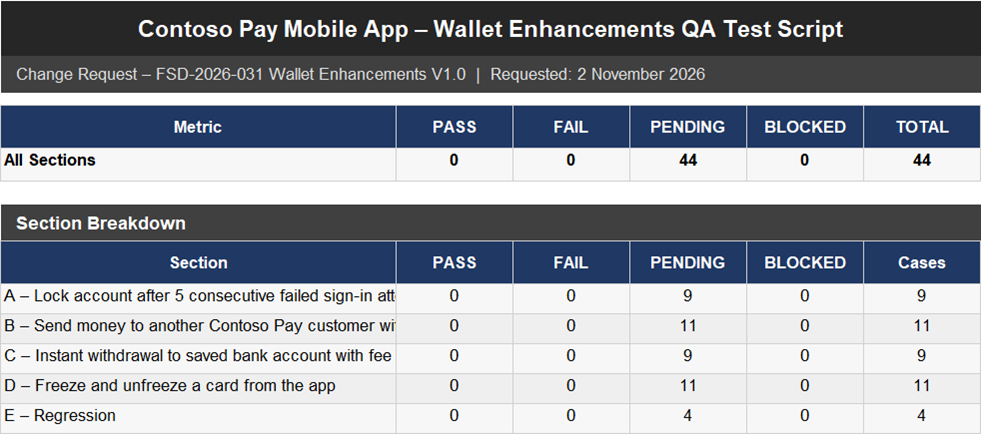
- 44 test cases in 5 sections, 100% criteria coverage, and every story passed the quality gate.
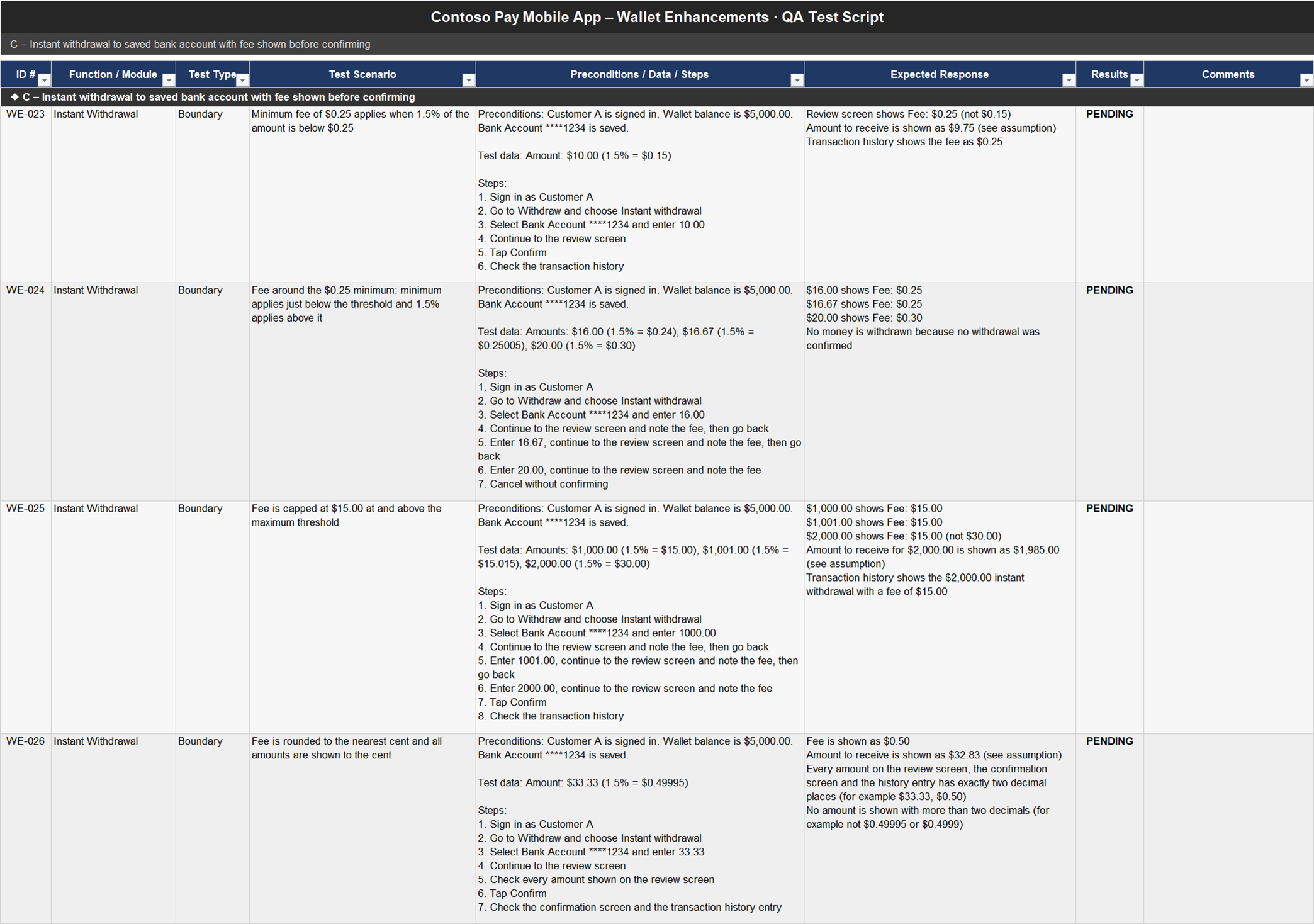
- Boundary tests at the document's own limits: $0.99 vs $1.00 minimum transfer, a $16.00 withdrawal hitting the $0.25 minimum fee, $1,000 and above capped at $15.00, and a $33.33 withdrawal whose fee rounds to $0.50. Wireframe details (the recipient, the $1,180.40 balance, the card's "block recurring payments" option) are used in the expected results.
- Unclear rules became questions, not guesses: is the daily limit a calendar day, is the fee deducted from the amount or charged on top?
- About 2 minutes and $0.71 in Claude usage for the whole document.
Testing found two real problems. On an earlier, larger sample, a re-run created duplicate stories because Claude rewords story titles between runs and the first version matched on titles. I replaced that with scope matching that is validated in code, and covered it with a test built from the failing run's data. The latest run showed that questions raised for the whole document and for each story overlap, which is the next thing to fix.
What this shows
End-to-end delivery automation across business analysis, Jira and QA. It combines document understanding (Word, PDF and wireframes), structured AI output with deterministic checks, safe and repeatable integration with Jira, and a test-script format that testers can use straight away. The step-by-step build guide and every line of code are in the repository.