Article
AI Governance Starts With Data Quality: Why Good Policies Can't Fix Bad Data
A well-governed model trained on messy, outdated or duplicate data will still give you bad answers. Why data quality should be the foundation of AI governance, plus five questions to ask before any AI system goes live.
Trevor Kauyu · November 15, 2026
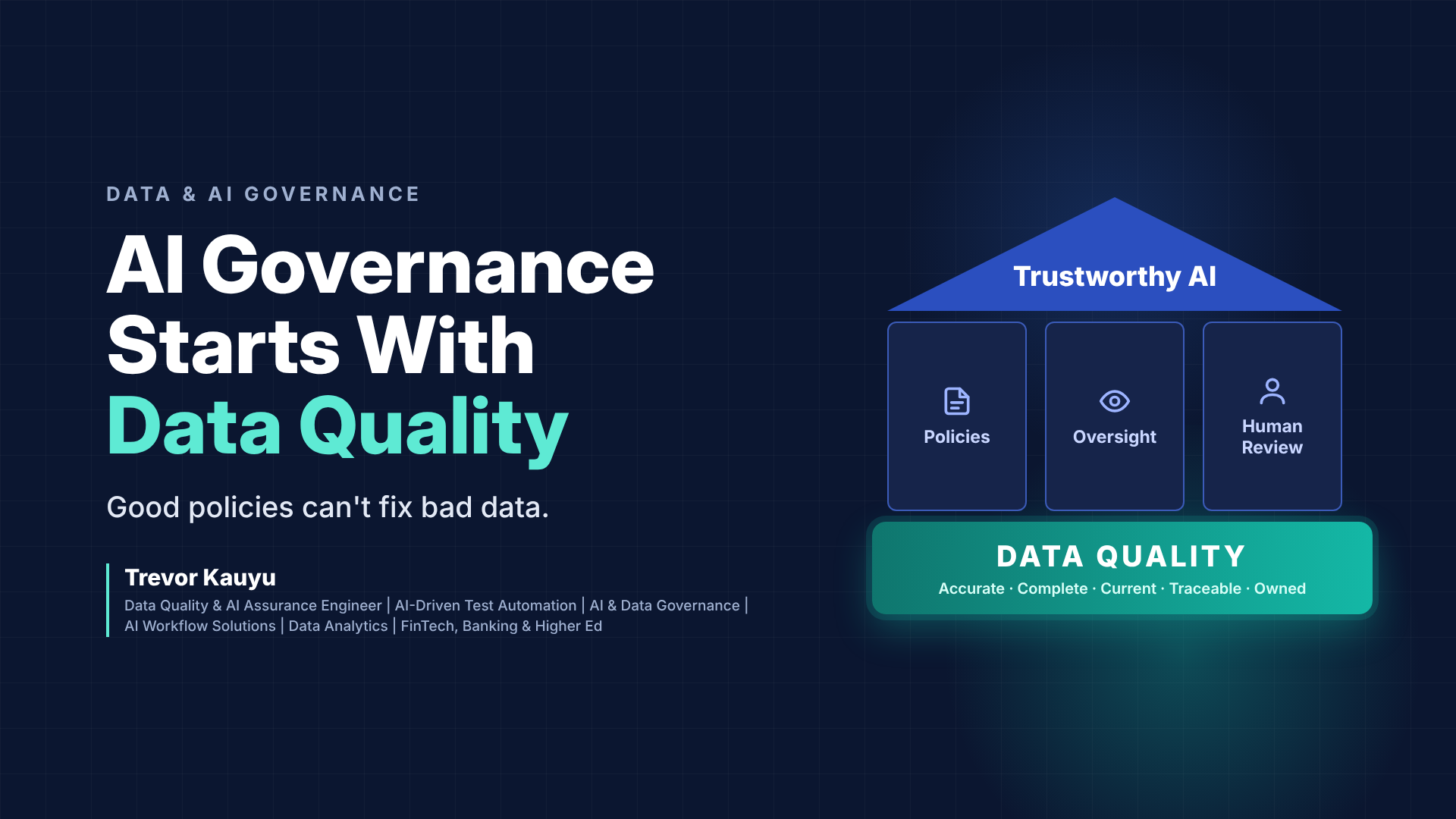
In my years working with data in banking and fintech, most of the problems I saw in reports didn't come from complicated code. They came from the data. A duplicate customer record. A field nobody updated. A table everyone used but nobody owned.
Now the same data is feeding AI systems. And the stakes are a lot higher.
A wrong number in a monthly report gets caught in a meeting. A wrong pattern learned by an AI model can quietly shape thousands of decisions before anyone notices.
How we usually talk about AI governance
When organizations start on AI governance, the conversation usually goes straight to policies, committees, risk assessments and model reviews. All of that matters.
But data quality often gets treated as someone else's job. It sits with the data team or IT, while governance happens in a different room.
That's a problem, because an AI system can only be as good as the data it learns from and works with.
A well-governed model trained on bad data still gives bad answers. You just get them with a policy attached.
Why data quality is a governance issue
Data quality is not just a technical detail. It affects the things governance is supposed to protect:
- Fairness. If the data is incomplete or skewed, the model can treat some groups unfairly without anyone meaning it to.
- Explainability. If you can't trace where the data came from, you can't explain why the AI made a decision.
- Compliance. Regulators are paying attention. The EU AI Act, for example, expects data used for high-risk AI systems to be relevant, representative and, as far as possible, free of errors and complete.
- Trust. Once people see an AI tool give a wrong answer with confidence, they stop trusting it, even when it's right.
What "good data" means for AI
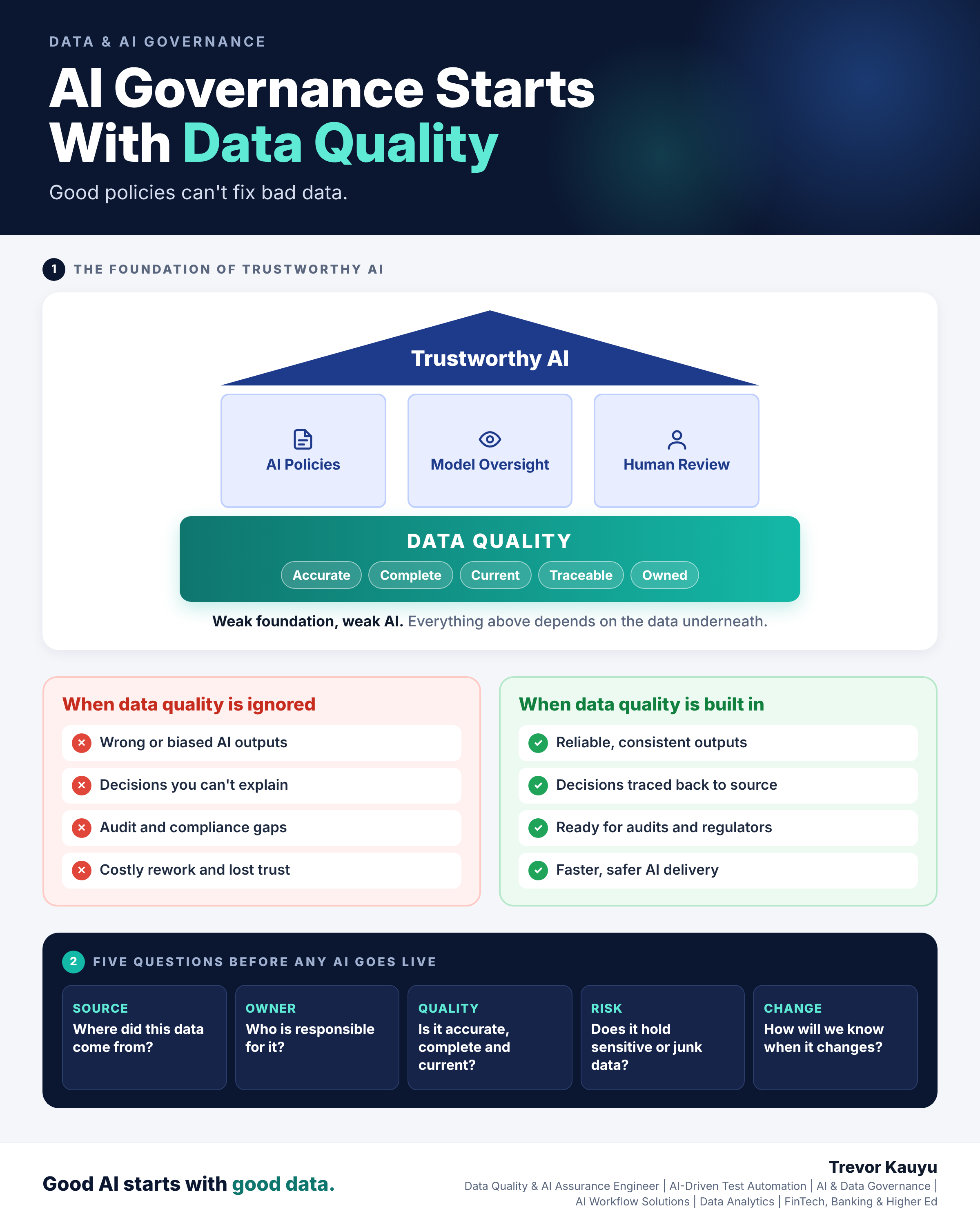
It doesn't need to be complicated. I think about it in five simple ways:
- Accurate. The data reflects what is actually true.
- Complete. Important fields and groups are not missing.
- Current. It's up to date, not a copy from three years ago.
- Traceable. You know where it came from and what happened to it along the way. This is data lineage.
- Owned. Someone is clearly responsible for it.
It also means cleaning out ROT data: the redundant, obsolete and trivial data that piles up over the years. It adds cost and risk, and it can quietly make AI results worse.
What happens when it's ignored
When data quality is left out of AI governance, the same problems keep showing up:
- AI outputs that are wrong or biased, with no clear reason why.
- Decisions that can't be explained to a customer, an auditor or a regulator.
- Audit gaps, because nobody can show where the data came from.
- Costly rework when problems are found after the system is already live.
None of these are model problems. They're data problems that look like model problems.
Five questions to ask before any AI goes live
If I could add one simple step to every AI project, it would be asking these questions before launch:
- Where did this data come from?
- Who is responsible for it?
- Is it accurate, complete and current?
- Does it contain sensitive data or junk data that shouldn't be there?
- How will we know when it changes?
If a team can't answer these, the system is not ready, no matter how good the model looks in testing.
It's not a one-time check
Data changes all the time. New sources get added, systems get updated, and people use AI tools in ways nobody planned. A data quality check done at launch can be out of date within months.
That's why data quality has to be monitored continuously, the same way we monitor security or system performance. Automated checks, clear owners and alerts when something drifts go a long way.
Final thought
AI governance often starts at the top with policies and principles. I think it should start at the bottom, with the data. Get the foundation right, and everything built on top of it becomes easier to trust.
How does your organization connect data quality and AI governance? Are they handled by the same people, or kept separate? I'd love to hear what's working.