Article
Shadow AI and Shadow Data: The Two Things Your Security Team Can't See
Shadow AI creates Shadow Data. What each term means, where they meet, what happens if you ignore them, and three steps to bring them into the light: find it, govern it, then enable it.
Trevor Kauyu · November 8, 2026
A few years ago, before most companies had any AI policy, I watched people around me paste SQL queries, client emails and spreadsheets into free AI tools. I did it too.
Nobody thought of it as a security problem. It was just a faster way to get work done.
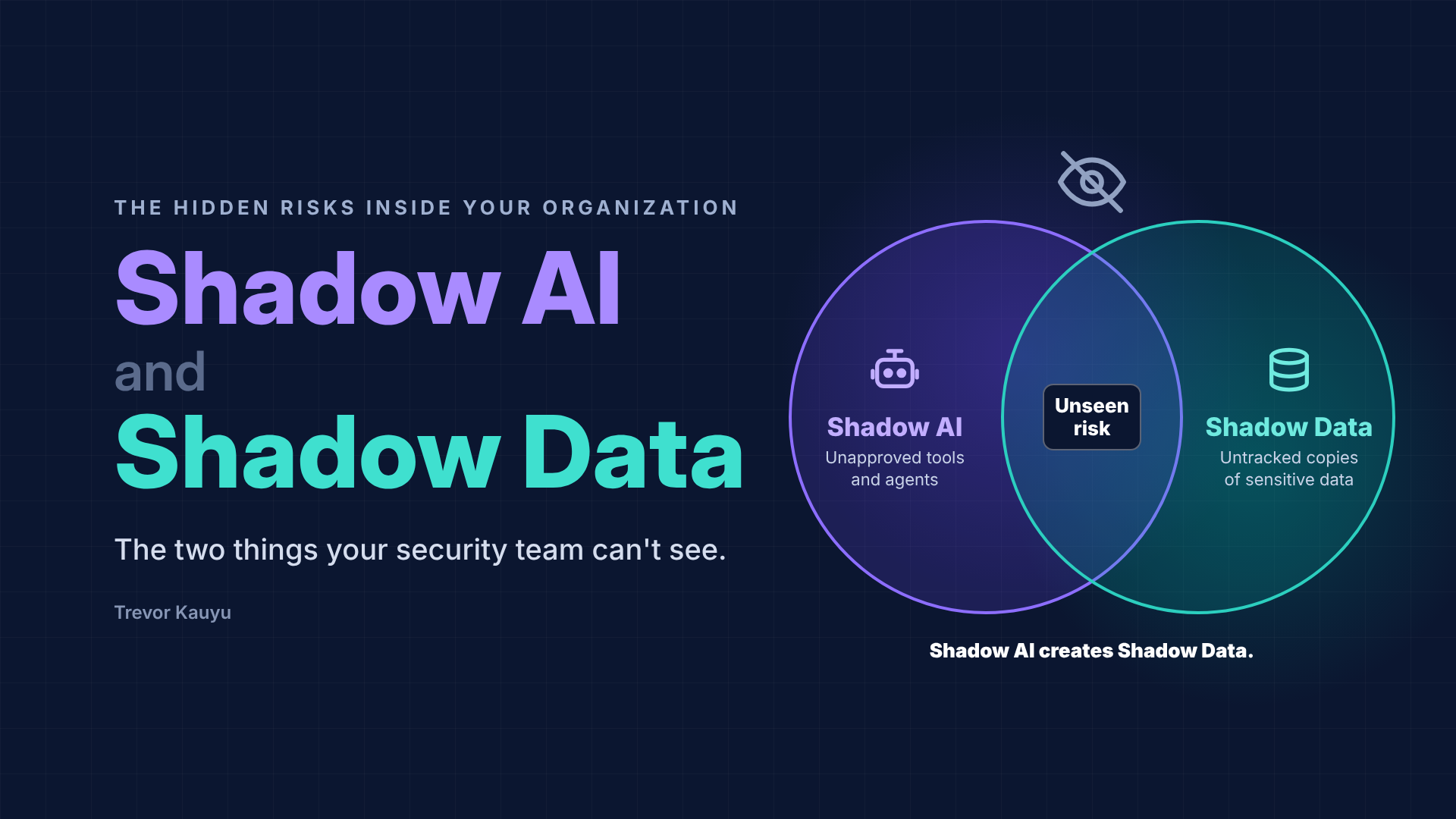
Looking back, that was Shadow AI. And every one of those pastes was creating Shadow Data.
These two terms get mixed up a lot, so I want to break them down simply.
What is Shadow AI?
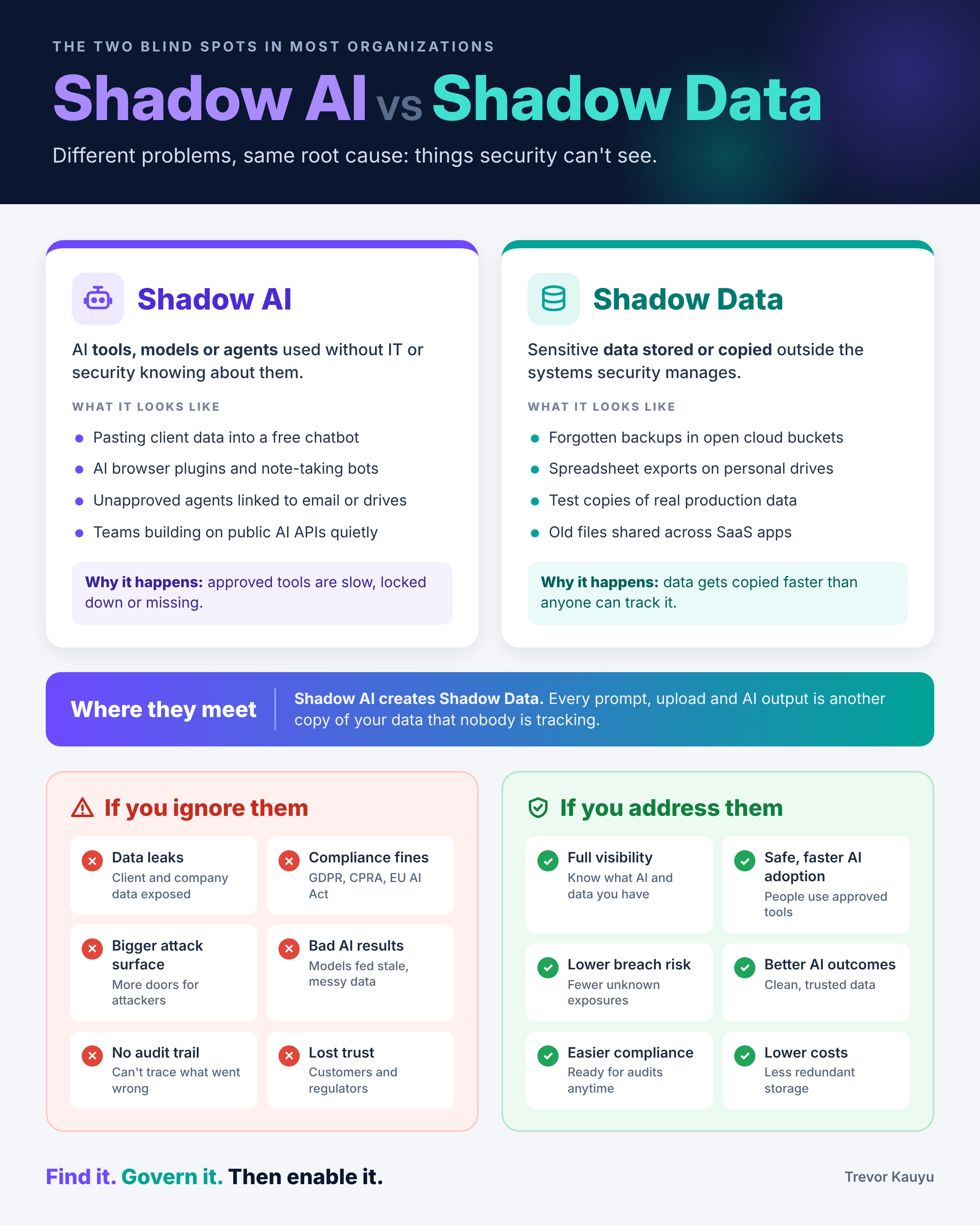
Shadow AI is any AI tool, model or agent that people use at work without IT or security knowing about it.
It could be someone using a free chatbot to summarize a contract. It could be a browser plugin that reads every page you open, or a note-taking bot that joins meetings. More and more, it is an AI agent someone connected to their email or shared drive because it saves them an hour a day.
Most of the time, people are not trying to break rules. They use these tools because the approved option is slow, hard to get, or doesn't exist yet.
What is Shadow Data?
Shadow Data is sensitive data that lives outside the systems your security team knows about and protects.
Think of an old database backup sitting in a cloud bucket, a customer list exported to someone's personal drive, a test environment loaded with real production data, or files shared in a SaaS app years ago and never cleaned up.
It happens because data gets copied much faster than anyone can track it. Every export, sync and "quick copy for testing" adds to the pile.
Where they meet
Shadow AI creates Shadow Data.
When someone pastes client information into an unapproved AI tool, that data now exists somewhere outside your control. The prompt, the upload and the output are all new copies. You don't know where they are stored, how long they are kept, or whether they are used to train a model.
So if you only focus on one of these, you are only solving half the problem.
What happens if you ignore them
The risks are not theoretical:
- Data leaks. Sensitive data can get out without anyone noticing until it is too late.
- Compliance trouble. GDPR, CPRA and the EU AI Act expect you to know where personal data is and how AI is used. "We didn't know" is not a good answer for a regulator.
- A bigger attack surface. Every unknown tool and forgotten data copy is another door an attacker can try.
- Worse AI results. Models fed old, messy or duplicate data give worse answers.
- No audit trail. When something goes wrong, there is no way to show what happened.
- Lost trust. Once customers lose trust, it is very hard to win back.
What you gain by addressing them
Fixing this is not only about reducing risk. It also makes the business better:
- Real visibility into what AI tools and data you actually have.
- Faster, safer AI adoption, because people have a good approved option.
- Lower breach risk, with fewer unknown exposures.
- Better AI outcomes from clean, well-governed data.
- Easier audits, because you can show where data is and who uses it.
- Lower storage costs once redundant and obsolete data is cleaned up.
So what should organizations do?
From what I have learned, it comes down to three steps.
1. Find it. You can't protect what you can't see. Tools like Data Security Posture Management (DSPM) can automatically discover and classify data across cloud, SaaS and AI systems, including data nobody remembered was there.
2. Govern it. Set clear, simple rules on which AI tools are approved and what data can go into them. Keep an eye on who has access to sensitive data and where it moves.
3. Enable it. This is the step people skip. If the approved AI tools are worse than the free ones, people will keep going around them. Blocking without a good alternative just pushes the problem further out of sight.
Final thought
Shadow AI and Shadow Data are not going away. AI adoption is only speeding up, and data keeps growing. The organizations that do well will be the ones that stop treating these as someone else's problem and start building visibility from the ground up.
I'd like to hear from others. Have you seen Shadow AI or Shadow Data in your organization? What has actually worked to bring it into the light?