Article
Toxic Combinations: Why Small Security Issues Add Up to Big Breaches
Most big breaches don't start with one big mistake. They start with a few small ones nobody connected. What toxic combinations are, how they played out at Target and Capital One, and four steps to break the chain.
Trevor Kauyu · November 1, 2026
Before I moved into data and AI governance, I spent years in QA automation. One lesson stuck with me: the worst bugs were rarely the ones a single test caught. They showed up when two or three "fine" pieces worked together.
Security works the same way.
Most big breaches don't start with one huge mistake. They start with a few small ones that nobody thought were worth worrying about. On their own, each one looks minor. Together, they open a door. In data security, this is called a toxic combination.
What is a toxic combination?
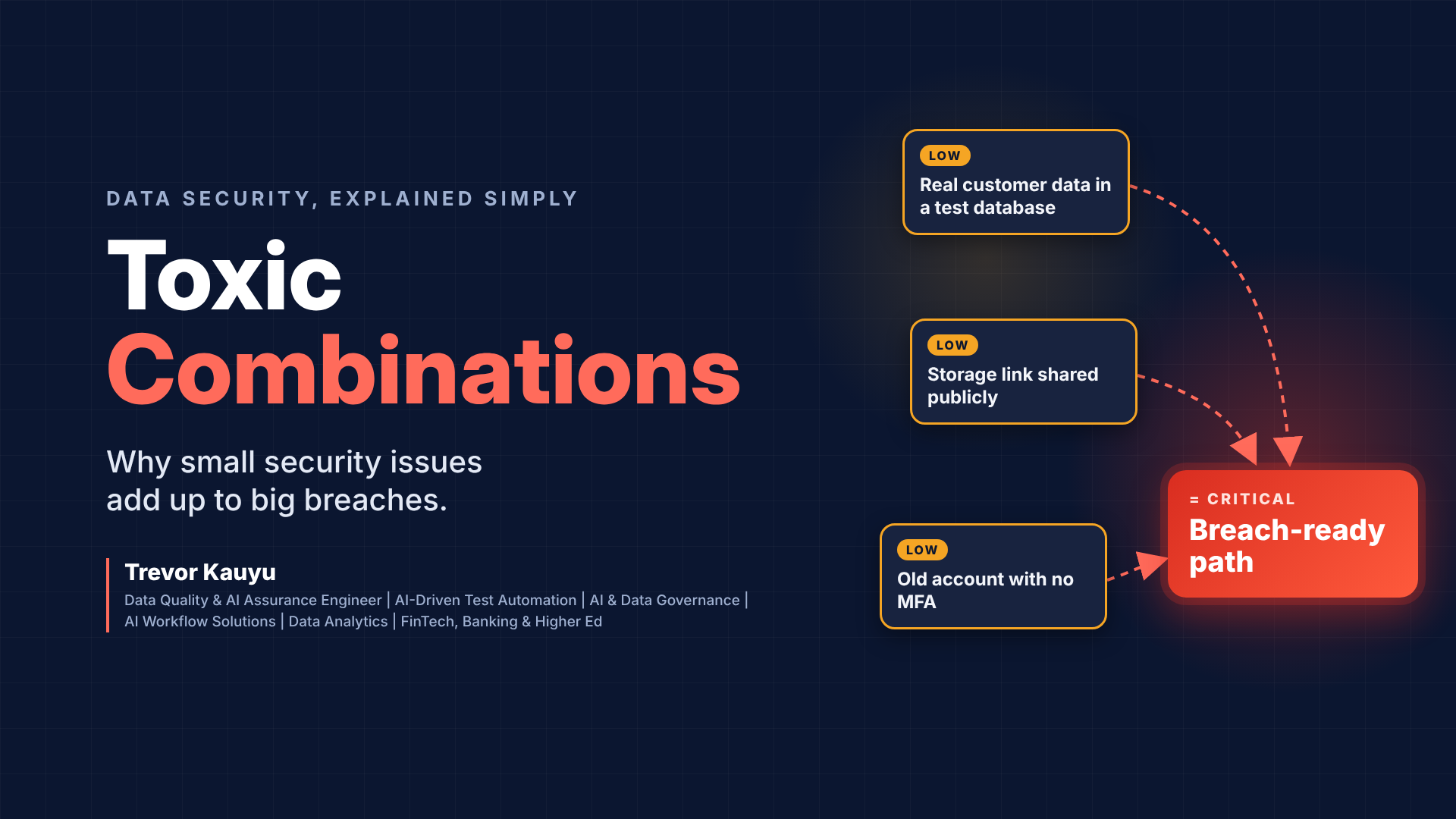
A toxic combination is two or more low-risk issues that, when they line up, create a high-impact risk.
Here is a simple example. Imagine a company with these three problems:
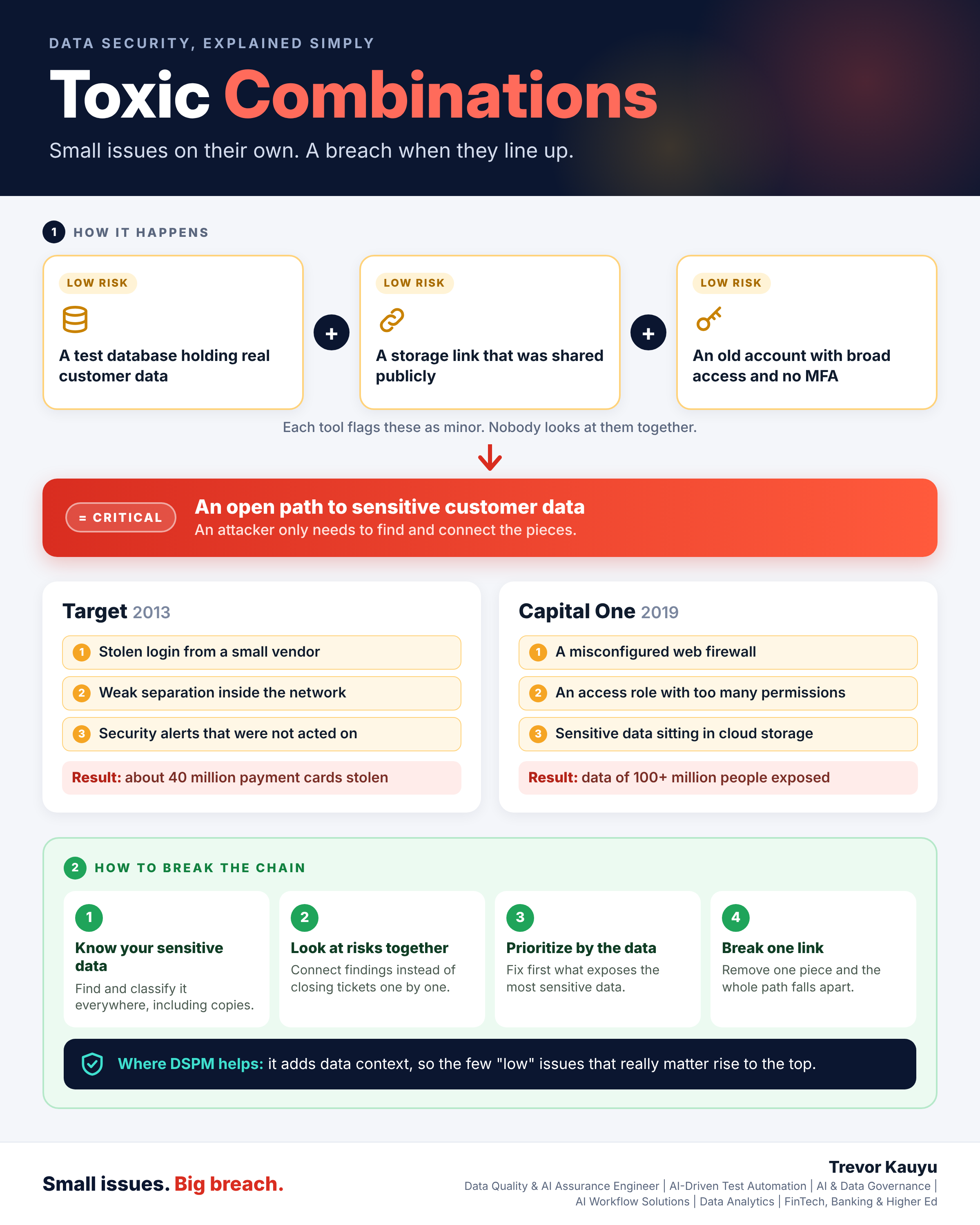
- A test database that was loaded with real customer data to make testing easier.
- A storage link to that database that someone shared publicly for a quick demo.
- An old service account with broad access and no MFA that nobody removed.
Each of these might show up as a "low" or "medium" alert in a different tool, owned by a different team. None of them feels urgent. But put them together and you have a clear path from the internet straight to customer data.
The attacker doesn't need one big hole. They just need to connect the small ones.
This has happened before
Some of the biggest breaches followed exactly this pattern.
Target (2013). Attackers got in using a stolen login from a small HVAC vendor. Inside, the network was not well separated, so they could move from vendor systems toward payment systems. Security tools did raise alerts, but they were not acted on in time. About 40 million payment cards were stolen.
Capital One (2019). A misconfigured web firewall let an attacker reach internal resources. An access role had far more permissions than it needed. And sensitive customer data was sitting in cloud storage that role could read. Data of more than 100 million people was exposed.
In both cases, no single issue told the full story. The damage came from how the pieces fit together.
Why our tools keep missing it
I think it comes down to three things.
Tools work in silos. One tool watches cloud settings, another watches access, another watches logs. Each sees its own piece, and nobody sees the chain.
Risk is scored one item at a time. A public link scores "medium." A test database scores "low." The tool doesn't know that the test database holds real customer data.
Alert fatigue. Teams get thousands of alerts. The low ones get pushed to "later," and later never comes.
Where DSPM helps
This is one of the ideas that stood out to me while studying Data Security Posture Management (DSPM). DSPM starts with the data. It finds where sensitive data lives, who and what can access it, and how it moves.
With that context, it can connect findings that look unrelated. A public link is no longer just a public link. It is a public link to a database with real customer data, reachable by an account without MFA. That changes the priority completely.
The goal is not more alerts. It is fewer, better ones that point to real risk.
What organizations can do
You don't need a big new program to start. A few habits go a long way:
- Know your sensitive data first. You can't spot a toxic combination if you don't know which systems hold sensitive data, including test copies and old backups.
- Look at risks together. Bring cloud, data and identity findings into one view instead of closing tickets one by one.
- Prioritize by the data exposed. A "low" issue touching customer data can matter more than a "high" issue on an empty server.
- Break one link. You often don't need to fix everything at once. Remove one piece, like that public link or the unused account, and the whole path falls apart.
Final thought
Big breaches rarely come from one big mistake. They come from small ones that sit together for too long. The organizations that stay safe are not the ones with zero issues. They are the ones that can see how their issues connect.
Have you come across a toxic combination in your own work? Something that looked small until you saw what it was connected to? I'd like to hear about it.